


Beau Laughed's Top 25 All-Time Great Masterpieces
This list is NOT a
“look how edgy I am” or
“I memorized art history 101” list.
Simple Technical Artistic Skill Measurement
Can any teenager copy it to a decent proficiency - not if it's a Master skill?


Countries Count


France - 7 Spain - 4 Italy- 4 Netherlands - 3 USA - 2 England - 2 Austria - 1 Finland - 1

.png)
Honorable Mention: Coke Cans and Bag - Puerto Rico
Pedro Campos, One Plus Gallery, London
note: this oil painting did not meet three criteria, but it's technical mastery is sublime

At first glance, the image appears indistinguishable from reality—Coca-Cola cans and a plastic bag rendered with extreme precision.
Light bends across aluminum surfaces, reflections shift within reflections, and the translucent plastic changes tone with every fold.
There is no narrative or symbolism driving the scene; its power lies entirely in execution precision.
This painting stands as a rare exception within the list, where technical mastery alone commands attention. It does not ask for interpretation—only recognition of the skill required to make the impossible feel effortless.
Comment Below on Your Choices
#25 Homeless - 1905, England
Thomas Kinnington -- Bendigo Art Gallery, Australia

The first element that draws the eye is the bundle beside the woman. Its light tone stands out against the muted scene, suggesting the most basic necessities of life—things that should be simple, yet are not.
The boy becomes the emotional center. His pale skin and limp posture emphasize fragility and innocence, presenting him as someone overwhelmed by forces beyond his control.
The woman leans in with urgency and care, but her dark clothing visually blends into the same shadowed world that has failed him.
The street is slick, the air thick with haze, and the distant structures fade into gloom, creating a setting that feels cold, impersonal, and indifferent.
Kinnington's statement of Victorian England places him alongside other artists, such as Charles Dickens, whose work condemns the emotionless English society.
#24 Fidelity -- 1869, England
Briton Riviere -- Tate Britain, London

The dog is the first element that draws attention. Its posture -- alert, gentle Expression -- clear concern, empathy and a desire to comfort.
The boy sits turned inward, his hand shields he pain on his face. His arm rests in a sling, indicating injury, and his posture turtles -- withdrawing inwardly.
His worn clothing, damaged shoes, and the bare interior place suggests poverty, where hardship isn't just temporary -- it's familiar.
The contrast between the dog and boy carries the meaning: the boy withdraws into his pain, while the dog opens himself with companionship and understanding without question.
#23 A Bar at the Folies-Bergère - 1882, France
Édouard Manet, Courtauld Gallery, London

There’s more happening here than at first glance. The barmaid stands at the center, her expression distant despite the lively setting behind her.
The real tension appears in the mirror, where a man stands close to her—yet the reflection doesn’t align with the main image, creating a subtle distortion of reality.
The objects in front of her—flowers, fruit, and bottles—show that this is a place where things are sold, and she is part of what’s being offered.
Together, the painting shows a lively scene that feels strangely empty, where connection is replaced by distance and what we see can’t quite be trusted.

#22 The Birth of Venus -- 1486, Italy
Sandilla Botticelli -- Uffizi Gallery in Florence, Italy

The first thing you notice is a woman standing on a large shell, floating on the water. Her body is shaped to look perfect rather than real, and she appears calm and unaffected by what is happening around her.
To the left, two winged figures blow wind, pushing her across the water. On the right, a woman stands on land, holding a cloth as if preparing to cover her when she arrives.
The scene shows a clear movement—from water toward land—but the figures do not react with urgency or emotion.
The composition is balanced and graceful, but lacks tension. Nothing resists or struggles; the moment unfolds without conflict.
Together, the painting presents an idealized image of beauty and arrival, focused on appearance rather than emotion or depth.

Our eyes are instantly drawn to the angel —light in every sense: her hair, her dress, her presence. Yet she is wounded, blindfolded, and unable to see -- very symbolic.
The boys stand in contrast—dark, heavy, and solemn — carrying her with expressions that suggest burden rather than purpose, as if humanity is left to carry what should be carrying them.
The landscape reinforces this duality: water suggests the spiritual, while the surrounding earth reflects the human world.
Simberg never explained the meaning, leaving the viewer to confront this reversal and decide what it asks of them.
#20 The Farewells -- 1911, Italy
Umberto Boccioni -- The Museum of Modern Art, New York

The Farewell captures the energy and confusion of departure. The eye is drawn first not to light, but to the bold numbers — 6943 — anchoring the scene in the modern world of trains, speed, and industry.
Around them, fragmented forms and overlapping lines suggest figures in motion, blending together as people embrace, separate, and dissolve into the moment of leaving.
The trains are not clearly defined but embedded within the chaos, their presence felt through force and direction rather than form.
Boccioni presents departure not as a single act, but as a collision of emotion and movement—where connection, separation, and time all blur together.
#19 The Kiss -- 1907, Austria
Gustav Klimpt -- Österreichische Galerie Belvedere Museum, Vienna

The Kiss presents an intimate embrace shaped by desire, control, and the contrast between masculine and feminine forms, symbolizing Freudian psychology, shaped by desire, control, and unification between masculine and feminine forms.
Covered in shimmering gold leaf tapestry, a couple is locked in an intimate embrace.
A man leans over a woman, holding her face as he kisses her cheek. He is adorned with vertical, rectangular shapes, symbolizing manhood and control.
The woman, covered in soft, circular patters, representing womanhood, closes her eyes in bliss to the passionate embrace -- surrendering.
The lush garden beneath them serves as a metaphor for fertility and intimate drive. The entire scene is modulated into a shape depicting an obvious and direct symbol of sexual energy and creation.
#18 The Happy Accident of the Swing -- 1767, France
- Jean-Honoré Fragonard -- Wallace Collection, London

The scene presents a calm afternoon in the park, yet the figures stand rigid and upright, arranged with deliberate geometric order. Vertical bodies and trees create a framework of stability, while parallel groupings of couples balance the composition with near-symmetry.
Seurat’s pointillist technique dominates the painting—form, light, and atmosphere are constructed entirely through precise dots of color, dissolving solidity into a controlled optical effect.
Despite the leisure setting, there is little interaction; each figure remains isolated within this structure. The result is a world of order and stillness that feels quietly artificial, where modern life appears composed, balanced, and emotionally distant.
#17 Napoleon Crossing the Alps -- 1801, France
Jacques-Louis David -- Musee de Louvre, Paris

Napoleon sits upright, composed, in control, pointing forward, commanding both his army and history.
The horse intensifies this image. It rears with energy, nobility, yet turbulent. Napoleon remains steady, strong, mastering his will to the other soilders to climp the alps.
The red cloak transforms the moment into spectacle. Bold and sweeping, it symbolizes power, ambition, and authority, elevating Napoleon from man to myth and drawing the eye to his constructed heroism.
Don't overlook the small troops below. These soldiers struggle up the mountain, burdened and grounded, embodying the physical effort and hardship that the leader himself appears to transcend.
Together, the painting is not a record of events but a deliberate myth—contrasting the visible struggle of many with the elevated image of one, and turning a harsh journey into a statement of power, control, and legend.
#16 The Garden of Earthly Delight -- 1500, The Netherlands
Heironymus Bosch -- Museo del Prado, Madrid
%20The%20100%20Best%20Paintings%20by%20Painters%20posted%20in%202016.png)
Together, the painting is not simply the Garden of Eden, but a full vision of humanity’s condition—beginning in innocence, surrendering to unchecked desire, and ending in consequence. Bosch presents Eden not as a place, but as a fleeting state, quickly lost as human impulse overtakes divine order. The totality suggests that paradise is not destroyed from the outside, but unraveled from within.
The first panel presents innocence. A quiet, ordered garden with Adam and Eve establishes a world untouched—balanced, natural, and calm. It represents a beginning, where humanity exists in harmony with the divine.
The central panel explodes into excess. The scene is filled with bodies, pleasure, strange forms, and impossible structures, all rendered with clarity and precision. It represents indulgence without restraint—humanity consumed by desire, curiosity, and sensation.
The final panel descends into punishment. The palette darkens, the forms become distorted and mechanical, and the figures are trapped in chaos and suffering. It represents consequence—pleasure turned into torment, order replaced by disorder.
Across all three panels, Bosch uses contrast—light to dark, order to chaos, innocence to corruption—to map a complete human cycle.
#15 Le Reveil, Her Mothers Kiss -- 1890, France
Eugene Carriere -- Musée d'Orsay, Paris

The light draws us to the kiss, but the meaning comes from the daughter’s face - the daughter below. Her gaze feels aware, almost anticipatory, as if she understands something the others do not.
.
Her intense expression is searching, feeling burdened. That tension transforms the kiss from a simple gesture into something uncertain and heavy.
The soft, fluid movement of the garments blurs their forms, implying the moment is slipping away,
There's ambiguity in the kiss. Who needs the comfort more—the mother or the child. The kiss could be reassurance, apology, protection… or farewell.
The second daughter eepens the unease.
Together, the painting resists clarity, allowing a single gesture to hold multiple meanings—love, fear, empathy, and possibly loss—making the moment feel less like affection and more like comfort.
#14 The Last Supper -- 1498 (Italy)
Leonardo Da Vinci -- the refectory of Santa Maria delle Grazie, Milan

The first impression is order—Christ sits at the center, calm and composed, while the apostles erupt around him in a wave of reaction. Each figure responds differently to the same revelation, their gestures and expressions capturing shock, denial, anger, and confusion. The composition is tightly controlled, with all perspective lines converging on Christ, whose triangular form anchors the entire scene in stillness.
This contrast between chaos and control gives the painting its power, as emotion spreads outward while meaning pulls inward. The scene captures a moment of betrayal already set in motion, where tension is present but contained, creating a balance between human reaction and divine certainty.
#13 A Sunday on La Grande Jatte -- 1884, France
Georges Seurat - The Art Institute of Chicago, Chicago

The scene presents a calm afternoon in the park, yet the figures stand rigid and upright, arranged with deliberate geometric order.
Vertical bodies and trees create a framework of stability, while parallel groupings of couples balance the composition with near-symmetry.
Seurat’s pointillist technique dominates the painting—form, light, and atmosphere are constructed entirely through precise dots of color, dissolving solidity into a controlled optical effect.
Despite the leisure setting, there is little interaction; each figure remains isolated within this structure.
The result is a world of order and stillness that feels quietly artificial, where modern life appears composed, balanced, and emotionally distant.
#12 The Girl with the Pearl Earring -- 1665, The Netherlands
Johannes Vermeer -- The Netheralands

The first thing you notice is the light—sharp and deliberate —falling directly on her eyes, drawing you into her gaze and holding it.
Vermeer uses chiaroscuro to perfection. His lines of light and darkness don't blend -- they battle -- creating a contrast of high drama in a single moment of attention.
Her expression feels immediate, as if she has just turned toward you, lips slightly parted, caught between thought and speech.
The headscarf and simple clothing suggest modest origins, while the luminous pearl earring—oversized and striking—feels out of place, as if it does not belong to her.
That contrast creates quiet tension, suggesting not just a portrait, but a moment of transformation—where identity, status, and self-image are being tried on as much as the earring itself.
#11 The Persistence of Memory, 1931, Spain
Salvador Dali -- Museum of Modern Art, New York

A barren shoreline stretches into stillness, where cliffs meet an eerily calm sea under an empty sky. Time seems to have abandoned the landscape entirely, leaving behind a silence that feels suspended rather than peaceful.
The composition is spare and deliberate, with objects arranged theatrically across the foreground — each form isolated, yet carefully balanced to guide the eye through a space that feels both shallow and infinite.
Edges soften and forms sag under an invisible force, as solid objects lose their rigidity and slip into fluidity as the physical world dissolves.
And then there is time itself — no longer fixed or mechanical. The melting clocks suggest not just distortion, but a deeper unease: that time is less a constant truth and more something we experience, stretch, and lose.
#10 The Raft of the Madussa -- 1818, France
Théodore Géricault - Musee de Louvre (Room 700), Paris
%20%E2%80%93%20.png)
At first glance, the scene is overwhelming—bodies piled together in darkness, some lifeless, others clinging to survival.
The figures rises in a triangular structure, which does three things:
1. organizes the chaos of the mass of bodies,
2. lifts the eye from death to struggle to hope. 3. creates tension by lifting the vision toward uncertainty.
This painting depicts one of the most harrowing disasters at sea, where survival came at an unthinkable cost.
A distant ship appears on the horizon, but its presence feels uncertain, leaving the moment suspended between rescue and despair.
#9 Nighthawks -- 1942, USA
Edward Hopper -- The Art Institute of Chicago

The first thing you notice is the harsh, artificial light, isolating the figures inside against the dark, empty street. The scene is viewed from the outside, not within, and there is no visible entrance, as if we are looking into a human exhibit.
Inside, the figures sit close together, yet remain disconnected. The couple does not touch. No one is drinking, gesturing, or engaged—only a quiet presence without connection.
Outside, the surrounding businesses are closed and lifeless, reinforcing a world that has shut down. Even the visible cash register inside the diner sits unused, suggesting a place meant for exchange that now offers none.
The muted red tones—on the woman, the counter, and the surrounding buildings—suggest not warmth, but a stalled energy. The woman’s dress may imply her presence is paid for, reinforcing the absence of genuine human connection.
Together, the painting presents modern life as isolation in plain sight—where people exist side by side, observed from a distance, but never truly connect.
#8 The Inspiration of St. Matthew -- 1602, Italy
Michelangelo Merisi da Caravaggio -- Contarelli Chapel, Rome

Light seduces you right away -- it's sharp and direct — descending from above onto Matthew and the angel.
Here, chiaroscuro is not just technique—it is the story. The light doesn’t simply reveal the moment of inspiration, it forces it into existence through violent contrast with the surrounding darkness.
That light creates tension in three ways: it reveals against resistance, it marks the intrusion of the divine into the human, and it illuminates a moment that remains emotionally unresolved.
Matthew is hunched and grounded, heavy with human effort, while the angel hovers above—weightless, instructing, insistent. One struggles to write, the other demands it.
The composition draws the eye upward in a triangular movement—from Matthew’s body, to his hand, to the angel—linking effort, guidance, and inspiration.
Together, the painting presents creation not as a gift freely given, but as a struggle—where inspiration descends, and man must fight to receive it.
#7 La Jaconde (The Mona Lisa) -- 1503, Italy
Leonardo da Vinci -- Musee de Louvre, Paris

.png)
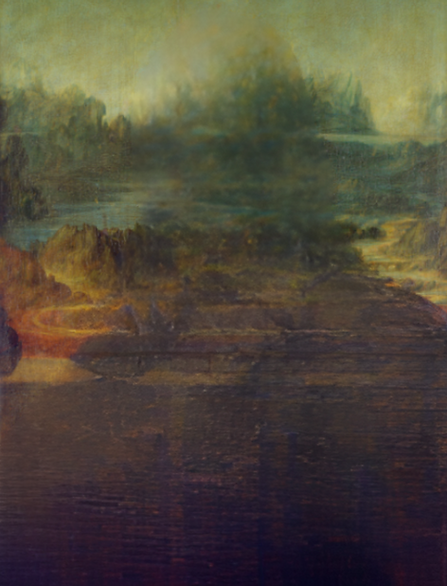
The landscape only
The untold key to her expression lies tucked behind her -- the landscape. It feels strangely unsettled—winding paths, distant waters, and uneven horizons that donsn't quite belong. The background:
-
makes her feel more grounded, almost above the chaos behind her
-
It introduces a faint unease you can’t quite name
-
It primes you to read her expression as shifting, because the environment itself refuses to settle
Against this dissonance, she sits composed, unshaken, counterbalancing a world that refuses to settle.
Her form is built on a subtle triangular structure, with her folded hands and gently angled shoulders creating a sense of balance that draws the eye inward and holds it there.
Light moves across her face and figure in soft, seamless transitions, with no sharp lines to anchor the gaze. This delicate blending gives her presence a lifelike, almost breathing quality.
And then there is the expression—elusive, shifting, never fully fixed. A smile that seems to appear and disappear, as if it belongs as much to the viewer as it does to her.
Mona Lisa — Smile Mechanism Add-on
The background and lighting prevent the viewer from settling on a single point. The eye moves continuously—from her eyes, to her mouth, to the distant landscape, and back again.
Because of this constant motion, the smile never stabilizes. When viewed directly, it appears restrained. When seen in peripheral vision, softened shadows make it appear more pronounced.
The result is a shifting expression that changes with each glance—not because the painting changes, but because the viewer does.
#6 The Penitent Mary Magdalan -- 1640, France
George de La Tour -- Metropolitan Museum of Art, New York

The candle is the first element that draws attention. It provides the only true source of light, making it both an earthly object and a spiritual symbol.
Magdalene herself is the next focus. Her face turns away from the candle, the mirror, and the skull, suggesting that her reflection is inward rather than fixed on the objects before her.
The skull introduces mortality. It reminds the viewer that repentance begins with the knowledge of death and the limits of earthly life.
The mirror adds self-examination. It does not reflect her face back to us, but instead deepens the sense that this is a moment of spiritual reflection rather than vanity.
The two flames—one real, one reflected—reinforce the tension between earthly life and spiritual contemplation.
The color carries meaning as well. The white of her gown suggests purity, while the red drapery recalls her former worldly life, showing not a complete break, but a transition.
Together, these elements combined present not a moment of repentance, but one of quiet understanding, where the physical world remains present, but no longer holds her attention.
#5 Orphelia -- circa 1851, France
Eugene Carriere -- Musée d'Orsay, Paris
%20Understanding%20Ophelia%20-%20YouTube.png)
Ophelia captures the final moments of a young woman drawn from Hamlet, suspended between life and surrender as she drifts along the water. The flowers in her hands carry symbolic meaning—love, innocence, grief—echoing her unraveling state of mind.
Her expression is calm, almost distant, and her open hands rest loosely at the surface of the water in an archetypal position of surrender. There is no struggle. No resistance. Only release.
Her dress, heavy with water, begins to pull her under—transforming grace into inevitability.
What elevates the painting is its obsessive natural detail. Every plant is rendered with near-scientific precision, transforming the riverbank into something both beautiful and overwhelming—nature not as backdrop, but as witness.
Together, the painting presents death not as violence, but as quiet surrender—where beauty, nature, and loss exist in the same breath.
#4 Liberty Leading the People -- 1830, France
Eugene Delacroix -- Musee de Louvre, Paris

Liberty surges forward at the center—bare-chested, unguarded, and defiant—leading not as an ideal, but as a force that cannot be contained. Her exposed body represents vulnerability and raw truth — stripped of protection, but also more spirit than symbol.
A young boy is actually a step ahead of her, signifying youth is leading the movement. The boy waves two pistols, charges, reckless and fearless, and looks like he's having the time of his life. Revolution here is not orderly—it belongs to anyone willing to step into it, signified by men of different classes marching, pulled into the same violent momentum. Many believe the man in the top hat is Delacroix himself.
The background swirls with smoke and chaos, yet beyond it, the sky begins to clear—suggesting that once the devastation is over, freedom will reign.
Beneath them, the dead are not hidden. Bodies lie in the foreground, grounding the movement in cost — reminding the viewer that liberty has a cost.
The composition is stabilized by a rising triangular surge. Death is the bottom layer and foundation, rising to action, leading to the blue skies of idealism, yet it never feels stable.
#3 Guernica -- 1937, Spain
Pablo Picasso -- Museo Reina Sofía, Madrid

There is no true center. The composition is fractured, forcing the eye to move without rest, mirroring the confusion and panic of the moment.
The absence of color strips away beauty, leaving only stark contrasts of black, white, and gray — like ash, smoke, and memory.
A light appears above -- but offers no hope.
From left, a mother collapses in anguish, clutching her dead child, her mouth open in a silent scream. Beside her, the rigid presence of a bull stands unmoved—watching.
Moving to the center, a horse writhes in pain, its body pierced and distorted, becoming the visual anchor in a painting that otherwise refuses stability. There's a glaring bulb exposes the suffering rather than relieving it.
Further right, figures stagger and reach—one trapped in flames, another stretching upward in desperation, as if searching for escape where none exists.
Together, the painting presents not a moment, but an experience of war—disoriented, relentless, and inescapable—where innocence, strength, and order are all shattered at once.
#2 Night Watch -- 1642, The Netherlands
Rembrandt van Rijn -- Rijksmuseum, Amsterdam

Action and movement immediately grips your attention — men loading weapons, sounding the drums, all locked into conversation. This isn't a posed portrait, but a company stepping into action.
Light drives the entire scene. It strikes the captain in black and the lieutenant in gold, establishing command and direction. The lieutenant’s ornate, almost ceremonial dress contrasts with the darker militia around him, elevating his presence and authority.
The lower half of the painting is illuminated and alive, while the upper dissolves into shadow. This contrast creates depth, but also suggests the transition — from preparation into action.
Scattered throughout, figures engage in separate moments — loading weapons, speaking, moving—creating controlled chaos rather than uniform order.
Then stands THE GIRL, glowing in gold, carrying a chicken -- a CHICKEN — an unexpected and living symbolic presence, representing civic duty. The chicken, their emblem, reinforces their role in protecting the city.
Touches of red—on the girl, the sash, and scattered details—introduce notes of violence and energy, reinforcing that this movement is not ceremonial, but dangerous.
The composition pulls the viewer into the scene,“while chiaroscuro directs attention to the key figures.
The painting transforms a formal group portrait into something alive—where order, identity, and motion collide in a moment just before action unfolds.
Undeniable #1 World's Best Masterpiece
Las Meninas -- 1656, Spain
Diego Valazquez -- Museo del Prado, Madrid

The figures gather around the young Spanish princess, Margarita Teresa, but their attention extends beyond her—toward the unseen king and queen, reflected only in the small mirror behind them.
This places the true subject -- the king and queen -- outside the canvas, pulling the viewer into the position of those being observed.
Every figure exists within this exchange—some aware, some distracted—while the dog alone remains untouched, indifferent to status or spectacle.
In the background, a woman leans in to speak to her husband -- her manner suggests words of judgement or gossip. The a man listens — with an expression of "Yes, dear."
Velázquez includes himself within the scene collapsing the roles of artist, subject, and viewer into a single moment. His canvas is the exact size of this painting -- we see him painting this very painting.
This is what separates Las Meninas: it is not just a painting to be viewed, but a system that includes you. It breaks the boundary between art and observer, turning the act of looking itself into the subject — something no other painting achieves with this level of control, complexity, and clarity.
Geometrical Composition

Precise geometric framework holds everything in place.
Nothing here is accidental. Every figure, every object, is deliberately placed
— held together by an invisible structure most viewers never notice.
Multiple triangular formations anchor the scene. The central triangle forms around the young princess, supported by her attendants, stabilizing the visual focus. To either side, secondary triangular groupings emerge
— maintaining balance without rigidity.
Vertical and rectangular elements reinforce the geometrical balance — the doorway, the large canvases, and the walls.
This carefully engineered composition feels natural and alive. Every figure, every space, is quietly guided by geometric order.